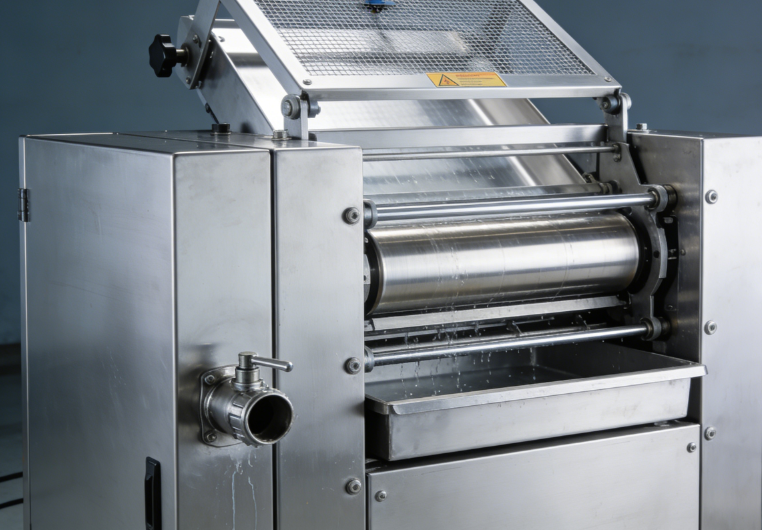
Packaging food products like meat, dairy, baked goods, or ready meals requires automatic packaging machines that go beyond speed and accuracy. Hygiene, easy cleaning, and regulatory compliance are non-negotiable. This buying guide covers everything from material grades to CIP (clean-in-place) capabilities.
Key Regulations for Food Packaging Machines
Depending on your market, you may need compliance with: FDA (US), EFSA (Europe), GMP (Good Manufacturing Practices), and FSMA (Food Safety Modernization Act). The machine must not introduce physical, chemical, or biological hazards.
1. Stainless Steel and Surface Finish
All product-contact parts must be 304 or 316 stainless steel. For acidic or salty foods (pickles, sauces), 316 is mandatory to prevent pitting. Surface finish should be Ra ≤ 0.8µm (mirror-like) to prevent bacterial adhesion. Non-contact frames should be at least 304 stainless or coated mild steel with a smooth finish.
2. Washdown Design Features
Machines in wet environments need IP65 or IP69K rating (resists high-pressure hot water jets). Look for: sloped surfaces to drain water, no horizontal ledges where food debris accumulates, sealed bearings, and food-grade lubricants (NSF H1). Avoid machines with exposed threads, crevices, or hollow tubes that can trap moisture.
3. Quick Tool-less Disassembly for Cleaning
Food safety regulations require frequent cleaning (daily or between batches). Choose a machine with no-tool removal of seal jaws, forming tubes, and product hoppers. Changeover to a clean set should take under 10 minutes. Some advanced machines have automatic cleaning cycles (CIP) that flush the product path with hot water and sanitizer.
4. Anti-Microbial Coatings and Materials
Some suppliers offer silver-ion or copper-infused coatings on contact surfaces to reduce bacterial growth. While not a substitute for cleaning, they provide an extra layer of safety for high-risk foods like raw meat or cheese.
5. Product Containment and Dust Control
Powders (flour, spices, protein powders) create explosive dust and contamination risks. Ensure the machine has sealed electrical enclosures, dust extraction ports, and anti-static film handling. For sticky or liquid products, drip trays and washdown nozzles should be integrated.
Common Food Industry Mistakes
- Buying a non-washdown machine because “we don’t use water” – but condensation or cleaning sprays will still corrode it.
- Ignoring accessibility – if you can’t reach all surfaces with a brush, you can’t clean it properly.
- Using standard lubricants that can drip into product – always specify NSF H1.
- No validation of seal integrity after cleaning – cleaning agents can degrade seal jaws. Request validation data.
Questions to Ask Suppliers
✔️ Is the machine certified to FDA CFR Title 21 or EC 1935/2004?
✔️ Provide material certificates for all contact parts.
✔️ What is the IP rating of the control panel and motors?
✔️ Show a video of a complete disassembly and reassembly for cleaning.
✔️ Does the machine have a self-diagnostic system for seal temperature drift (food safety risk)?
Case Study: Salad Dressing Packer
A dressing manufacturer bought a low-cost automatic filler without washdown features. Within 6 months, corrosion inside the filling nozzles led to a mold contamination recall costing $500,000. They replaced it with an IP69K-rated machine with CIP. The higher upfront cost ($120k vs $70k) was recovered by avoiding one recall.
When buying for food applications, always prioritize hygiene features over speed or price. A clean machine is a safe machine, and safety protects your brand.