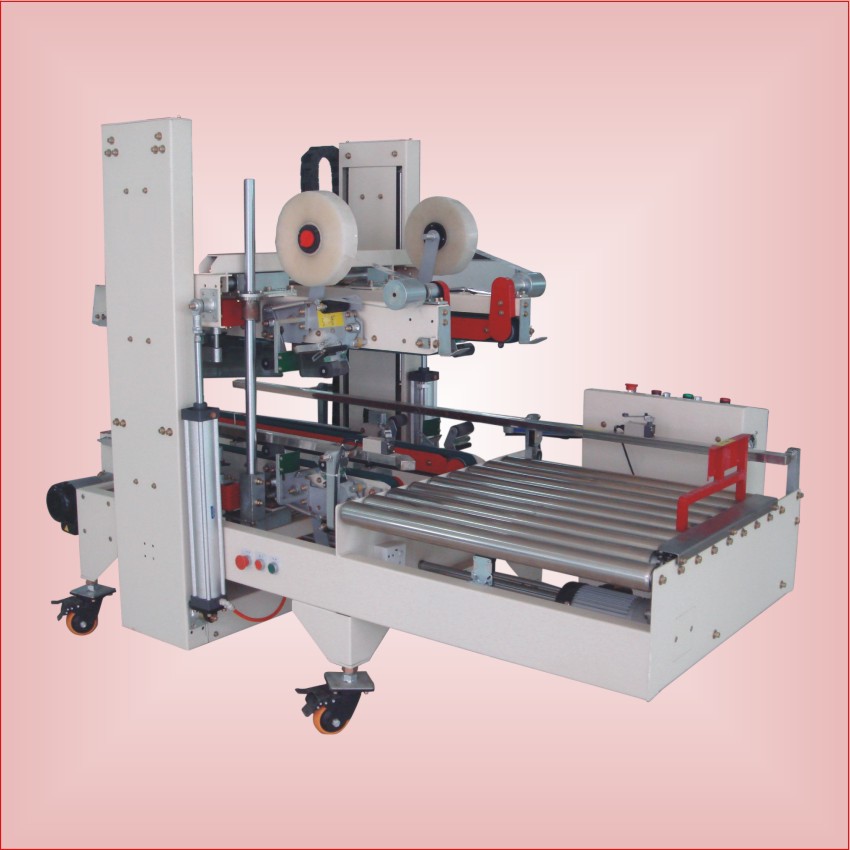
Two flow wrappers. Same frame size, same output on paper, one is 18,000 dollars and the other is 45,000. The salesperson for the cheaper one says servos are overkill. The salesperson for the expensive one says mechanical machines belong in a museum.
Both are wrong, and the difference is easier to understand once you look at what actually moves inside the machine.
How a mechanical wrapper works
One main motor turns a shaft. That shaft drives cams and linkages which move the film feed, the end sealers, and the cut-off in fixed relation to each other. Change the pack length and you swap gears or adjust a cam. Change the product and you may need to change the whole timing chain.
That sounds primitive. It is also why a mechanical wrapper made in 1998 is still running in a bakery somewhere, with the original motor.
How a servo wrapper works
Each motion has its own motor and its own program: film feed, end sealer, cut-off, infeed. A controller keeps them in sync through software rather than a cam shaft, so changing a pack length is a number on a screen, and the sealing jaws can be told to slow down for a fragile product.
That is the whole argument. Everything else in this comparison follows from it.
Where mechanical still wins
One product, one size, all year. If you run a single biscuit in a single pack, the flexibility of servos buys you nothing you will use.
A dusty or abrasive environment. Flour dust and sugar kill encoders and fans. A cam-driven machine has fewer sensitive parts to protect.
Local repair capability. A mechanical fault is usually a worn bearing, a stretched chain, or a broken spring, and a good fitter can fix it with the machine in place. A servo fault needs a laptop, a manual, and sometimes a factory password.
Budget, honestly. At 18,000 versus 45,000 dollars, the mechanical machine can be the right call for a small plant that will never change its packaging.
Where servo pays for itself
Changeover. This is the big one. A mechanical wrapper changing from a 65 mm to a 95 mm pack might take 60 to 120 minutes with tools. A servo machine recalls the recipe in five. If you change format twice a week, that alone can be 100 hours a year.
Film waste at startup. Servo film feed finds registration faster and holds it. On printed film, the difference in startup waste often runs 30 to 50 percent.
Fragile product. Independent sealing jaw motion lets you slow the jaw at the moment of contact, which matters for wafers, filled biscuits, and anything with a soft centre.
Diagnostics. A servo drive logs the fault, the position, and the load at the moment of failure. A mechanical jam gives you a broken pack and a guess.
Noise and energy. Fewer mechanical shocks, lower standing noise, and no clutch slipping all day.
The cost gap, over three years
Take a bakery running 60 packs a minute, two shifts, five days. The servo machine costs 27,000 dollars more. Set against that: 90 fewer minutes per changeover, twice a week, at 60 packs a minute, is roughly 10,800 extra packs a week of capacity, plus the film waste saving and the labour saving on setups.
For most plants at that volume, the gap closes inside two years. For a plant running one SKU on a single shift, it never closes, and that is a perfectly good reason to buy the mechanical machine.
The middle option nobody mentions
Plenty of machines are “half servo”: servo film feed and servo cut-off, but mechanical sealing jaws, or the reverse. That configuration gets you fast registration and short changeover for a much smaller price increase, and it is often the sensible answer for a first automatic line.
Ask specifically which axes are servo and which are mechanical. “Servo machine” without that breakdown is a marketing phrase.
What to check in a demo
- Time an actual changeover, twice, with the operator who will do it in your plant
- Watch startup waste on printed film, and count the bags thrown away
- Run at 50 percent speed and listen for jaw chatter
- Ask what happens when the film runs out mid-cycle, and whether the machine stops cleanly
- Check whether recipes are stored by product name or by number, because operators will not remember numbers
If you are still deciding between machine architectures, our VFFS vs HFFS comparison covers the bag-forming side of the same question, and the flow wrapper range shows where the mechanical and servo models sit.
Frequently asked questions
Is a servo wrapper harder to maintain?
Not harder, different. There are fewer mechanical wear parts, but faults need diagnostic skills and a spare drive on the shelf. Budget for one spare servo drive and one backup of the program.
Can I retrofit servos to a mechanical machine?
Technically yes, practically rarely worth it. The cost of drives, controllers, and rewiring usually lands within 60 percent of a new machine, without the new frame or the warranty.
How much faster is a servo wrapper?
Peak speed is often similar. The real gain is sustained speed, because a servo machine recovers from a film splice or a product gap in seconds instead of minutes.
What about a dual lane machine instead?
Two lanes on one frame roughly doubles output for less than two machines, but changeover and jam clearing become twice the work. Choose dual lane for long runs, not for high-SKU plants.