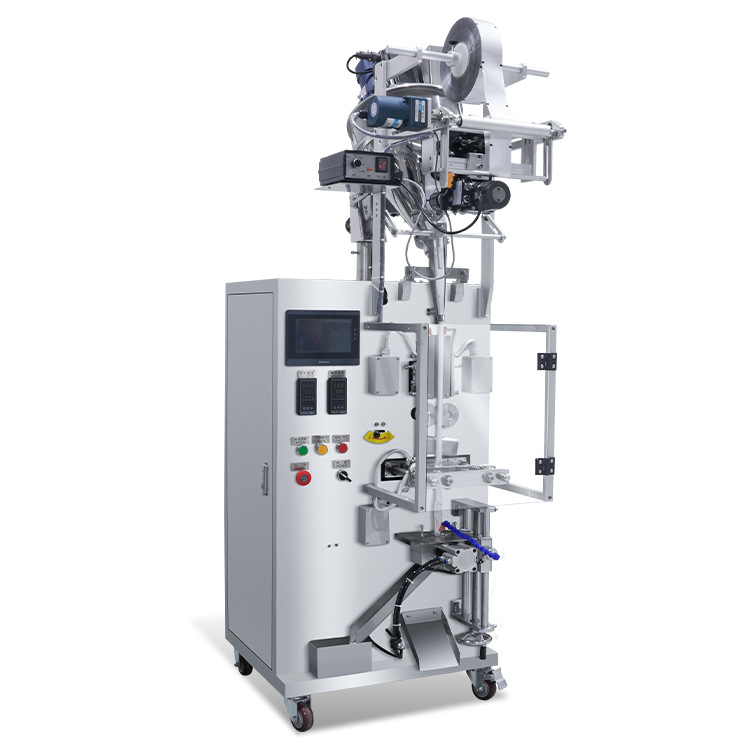
The weigher is the part of a packaging line that decides whether you make money or give product away, and it is usually the part buyers understand least. Two machines, both described as “automatic weighing”, one at 8,000 dollars and one at 35,000. The cheap one is not a scam. It is a different tool for a different job.
Two ways to hit a weight
A linear weigher fills a weigh bucket until the load cell reads your target, then stops. It is sequential, so speed is limited by how fast product can fall and settle.
A multihead weigher spreads product across 10 to 16 hoppers, weighs each one, and then the computer picks the combination of hoppers that adds up closest to your target. It never fills to a weight, it selects to a weight, which is why it is faster and more accurate at the same time.
What accuracy is worth, in money
On a 100 g pack, a linear weigher typically holds plus or minus 2 to 4 g. A 14-head multihead holds plus or minus 0.5 to 1 g. That sounds like a technicality until you price the giveaway.
Say you pack 20,000 bags a day and the average overfill is 1.5 g. That is 30 kg of product given away every day. At 8 dollars a kilo, it is 240 dollars a day, roughly 72,000 dollars a year, for product nobody paid for.
A 25,000 dollar difference in weigher price looks different against that number. This is the calculation that should drive the decision, not the quote.
Where a linear weigher is genuinely enough
- Large packs with wide tolerances. A 5 kg bag of potatoes or a 10 kg sack of pellets does not need half-gram accuracy, and the law does not ask for it.
- Low value product. If the product costs 80 cents a kilo, giveaway is noise.
- Slow lines. Below 30 packs a minute, a well-tuned linear weigher keeps up and costs a fraction.
- Sticky or clumpy product. Multiheads hate product that bridges. A belt-fed linear system with a scraper handles it better.
Where only a multihead works
- High speed. Above 60 packs a minute, a linear weigher physically cannot settle fast enough.
- High unit value. Nuts, coffee, freeze-dried fruit, supplements. Every gram matters.
- Legal net content rules with tight tolerances. Where the average must not fall below the declared weight, the multihead’s narrow spread is the cheapest compliance you can buy.
- Mixed pieces. The combination principle naturally averages out piece weight variation, which a linear weigher cannot do.
The exceptions that catch people out
Sticky product. Dried fruit, glazed nuts, and anything with surface sugar will coat the hoppers and slow the feed. Look for dimpled or coated hoppers, or a belt weigher instead.
Long or large pieces. A 200 mm biscuit does not fit a standard hopper. You need a wide-mouth version, which costs more and runs slower.
Fragile product. Multiheads drop product repeatedly through the feed cone. If breakage matters, ask for a gentle feed and a lower drop height, or consider a linear system with a soft transfer.
Very small doses. Under 5 g, you are in auger or counting territory, not multihead territory.
Integration is where cheap weighers get expensive
The weigher has to talk to the bagger. That means a timing signal, a ready signal, a dump signal, and a shared clock, and it means the discharge chute must line up with the forming tube without product bouncing off the shoulder.
A 9,000 dollar weigher with no interface documentation and no one who can commission it will cost you more in engineering hours than the 12,000 dollars you saved. Ask two questions before you buy: does it come with a wiring and protocol document, and can the supplier commission it remotely with your electrician on site.
Decision table
| Your situation | Sensible choice |
|---|---|
| Snacks, 80 packs per minute, tight weight law | 14-head multihead |
| Coffee, 40 packs per minute, premium product | 10-head multihead with degassing |
| Frozen dumplings, sticky, 45 packs per minute | Multihead with non-stick hoppers, or belt weigher |
| 5 kg rice bags, 25 bags per minute | Linear weigher |
| Hardware kits, counted pieces | Counting scale, not a weigher |
| Powder, 1 kg, 30 bags per minute | Auger filler with check weighing |
If you are sizing the whole line rather than just the weigher, read how to match machine capacity to production volume first, then look at the VFFS range for the bagger side of the pairing.
Frequently asked questions
Can a linear weigher be accurate to one gram?
On a 50 g dose with free-flowing product and a good vibratory feed, close. On a 500 g dose, no. Accuracy in absolute grams scales with the dose, so compare as a percentage before you decide.
Do I need a checkweigher as well?
If you have legal net content obligations, yes. A checkweigher verifies what the weigher produced and rejects outliers; the weigher alone cannot prove compliance.
How long does a multihead take to set up?
A good technician needs one to two days to tune feeds, combination limits, and dump timing on a new product. Budget that time into commissioning, not into the first production week.
Is a used multihead a good buy?
Sometimes. Check the load cells, the hopper condition, and whether the controller software is still supported. Hopper wear on abrasive product is the usual reason a used unit is for sale.