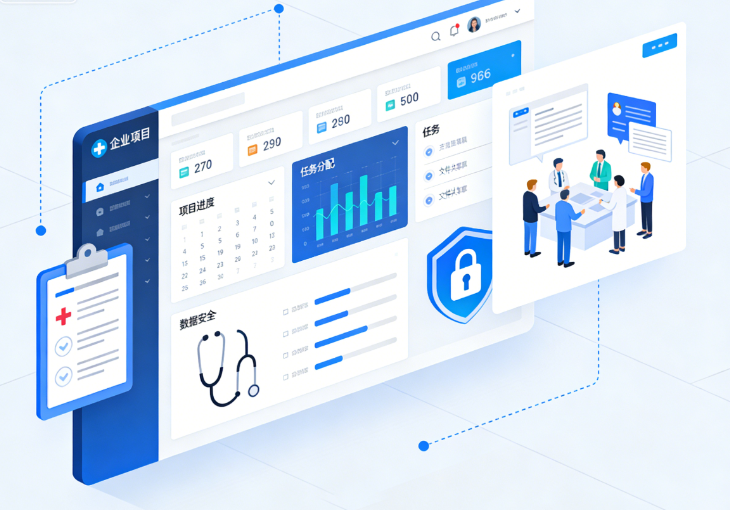
In today’s rapidly evolving healthcare landscape, enterprises face a unique challenge: delivering complex projects efficiently while safeguarding protected health information (PHI). Traditional project management tools like Asana, Trello, or Jira were not built with healthcare compliance in mind. This gap has given rise to HIPAA compliant project management software for healthcare enterprises – a specialized category of tools designed to meet the stringent administrative, physical, and technical safeguards required by the Health Insurance Portability and Accountability Act.
Why Healthcare Enterprises Need HIPAA Compliant Project Management
Healthcare organizations manage hundreds of simultaneous projects – from clinical trial coordination and EHR implementation to telemedicine rollouts and facility expansions. These projects inevitably involve PHI: patient schedules, provider notes, billing data, or device identifiers. Using standard project management software exposes healthcare enterprises to data breaches, OCR fines, and reputational damage. A HIPAA compliant solution ensures that every task, file attachment, comment, and calendar event is encrypted, access‑controlled, and auditable.
Core Features of HIPAA Compliant Project Management Software
When evaluating solutions, healthcare enterprises should look for the following non‑negotiable features:
-
End‑to‑end encryption – Data must be encrypted at rest (AES‑256) and in transit (TLS 1.3).
-
Access controls & role‑based permissions – Only authorized personnel can view, edit, or share PHI‑related project data.
-
Automatic audit logs – Every action (login, file download, status change) must be recorded for at least six years.
-
Business Associate Agreement (BAA) – The vendor must sign a BAA, assuming legal liability for PHI protection.
-
Secure messaging & file sharing – Internal comments and attachments must never leave the encrypted environment.
-
Two‑factor authentication (2FA) & SSO – Prevents unauthorized access from compromised credentials.
-
Data backup & disaster recovery – Ensures project continuity without PHI loss.
Benefits of Implementing a HIPAA Compliant Project Management System
-
Reduced compliance risk – Automated safeguards minimize human error.
-
Faster project delivery – Teams collaborate without fear of violating HIPAA.
-
Simplified audits – Built‑in audit logs provide immediate evidence for OCR requests.
-
Interoperability – Many solutions integrate with EHRs (Epic, Cerner) and billing systems.
-
Scalability – Supports enterprise‑level projects across multiple facilities or states.
Top Use Cases in Healthcare Enterprises
-
Clinical trial management – Track patient recruitment, consent forms, and adverse event reporting.
-
Hospital construction projects – Coordinate contractors while keeping blueprints and patient flow plans secure.
-
Telehealth rollout – Manage device deployment, provider training, and patient communication schedules.
-
Revenue cycle optimization – Monitor billing process improvements without exposing payment data.
-
Regulatory response – Create task lists for addressing OCR corrective action plans.
How to Choose the Right Software
Start by requesting a demo and reviewing the vendor’s SOC 2 Type II report alongside their BAA. Ask specific questions:
-
Do you encrypt metadata (task titles, descriptions)?
-
Can we restrict PHI access to only certain project folders?
-
Are audit logs exportable in CSV/JSON format?
-
Do you support on‑premises or dedicated cloud deployment?
Leading solutions in this space include PlanGrid (for construction), Bridge, Wrike (with BAA), and SmartSheets (enterprise tier). However, always verify current HIPAA compliance directly with the vendor.
Implementation Best Practices
-
Conduct a risk assessment – Identify where PHI enters your project workflows.
-
Define data classification – Mark projects as “PHI‑sensitive” vs. “administrative only”.
-
Train all project team members – Include HIPAA module in project onboarding.
-
Enable session timeouts and device management – Prevent unattended access.
-
Run quarterly mock audits – Use the software’s audit log to simulate OCR review.
Future Trends
Artificial intelligence is entering healthcare project management – predictive scheduling, resource allocation, and even automated compliance checks. However, AI models must be trained on de‑identified data to remain HIPAA compliant. Expect more integrations with health information exchanges (HIEs) and real‑time patient safety dashboards.
Conclusion
HIPAA compliant project management software for healthcare enterprises is no longer a luxury – it is a regulatory necessity. By adopting a purpose‑built platform, healthcare organizations can accelerate digital transformation while keeping patient data inviolable. Evaluate your current project tools; if they cannot sign a BAA, it is time to switch.