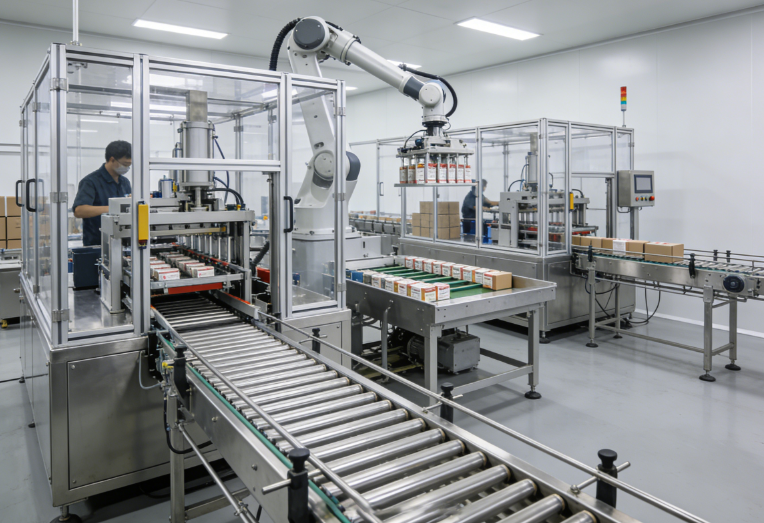
The term “automatic packaging machine” can mean anything from a standalone bagger to a fully synchronized packaging line with vision inspection and robotic case packing. This guide defines automation levels and helps you select the right degree of automation for your operation.
Level 0: Manual Packaging
Operators weigh, fill, seal, and label by hand. No machine. Only suitable for very small volumes (<500 packs/day) or highly variable products. High labor cost, inconsistent quality.
Level 1: Semi-Automatic Machines
Operator places bag or container, machine fills and seals. Typical machines: manual bagging stations with impulse sealers, or tabletop fillers. Speed: 5–15 packs/minute. Best for startups or low-volume specialty products. Price: $2k–$10k.
Level 2: Standalone Automatic Machine
A single machine that automatically forms, fills, and seals. Operator only loads film and removes finished bags. Speed: 20–80 PPM. No integration with upstream/downstream equipment. Good for medium volumes and simple packaging. Price: $15k–$50k.
Level 3: Automatic Line with Material Handling
The packaging machine is integrated with: automatic film splicer (reduces downtime), vacuum loader for product hopper, metal detector/checkweigher, and a simple belt conveyor to a manual case packer. This level removes most manual handling except case packing. Speed: 40–120 PPM. Price: $40k–$120k.
Level 4: Fully Integrated Line (Industry 4.0)
All equipment communicates via a central control system. Includes: automatic destacker for empty cases, robotic pick-and-place for bag-in-box, labeler, case sealer, palletizer, and stretch wrapper. Real-time OEE dashboards, remote diagnostics, and predictive maintenance alerts. Speed: 100–300+ PPM. Price: $200k–$1M+.
How to Decide the Right Automation Level
- Annual volume < 1 million packs: Level 1 or 2 is sufficient.
- Annual volume 1–10 million packs: Level 3 with automatic checkweigher and case packing help.
- Annual volume > 10 million packs: Level 4 full integration is cost-effective due to labor savings and reduced downtime.
- High product mix with short runs: Level 2 or 3 with quick changeover; Level 4 may be overkill.
- Single product, high volume, 24/7: Level 4 pays back fastest.
Key Technologies in High-Level Automation
Vision inspection systems: Cameras check fill level, seal integrity, date code presence. Reject faulty packs automatically.
Collaborative robots (cobots): Work alongside humans without safety cages. Ideal for picking and placing bags into cases.
MES (Manufacturing Execution System) integration: The packaging line receives production orders from ERP, reports actual counts, material consumption, and downtime reasons.
Predictive maintenance: Vibration sensors and thermal cameras on motors and bearings predict failures before they happen.
Automation ROI – Labor Savings Example
Manual case packing (Level 2): 2 operators at $40k/year each = $80k/year. Adding a robotic case packer (upgrade to Level 4) costs $70,000 one-time. Eliminates both operators. Payback = 10.5 months. Over 5 years, savings = $400k – $70k = $330k.
Common Mistake: Over-Automating
Buying a fully integrated line when your product changes every week leads to excessive changeover downtime and frustrated operators. Match automation level to your runtime per job. Rule of thumb: If a job runs less than 4 hours, keep automation at Level 3 or lower; if jobs run 8+ hours, invest in Level 4.
Future-Proofing Your Automation Choice
Even if you start with Level 2 today, choose a machine whose controller has open communication ports (Ethernet/IP, OPC UA) and can later integrate with upstream/downstream devices. Also ensure the supplier offers upgrade kits (e.g., adding a robotic case packer later).
By understanding these five levels of automation, you can match your investment to your actual production needs – neither over-spending on unused features nor under-spending on a machine that will bottleneck your growth.