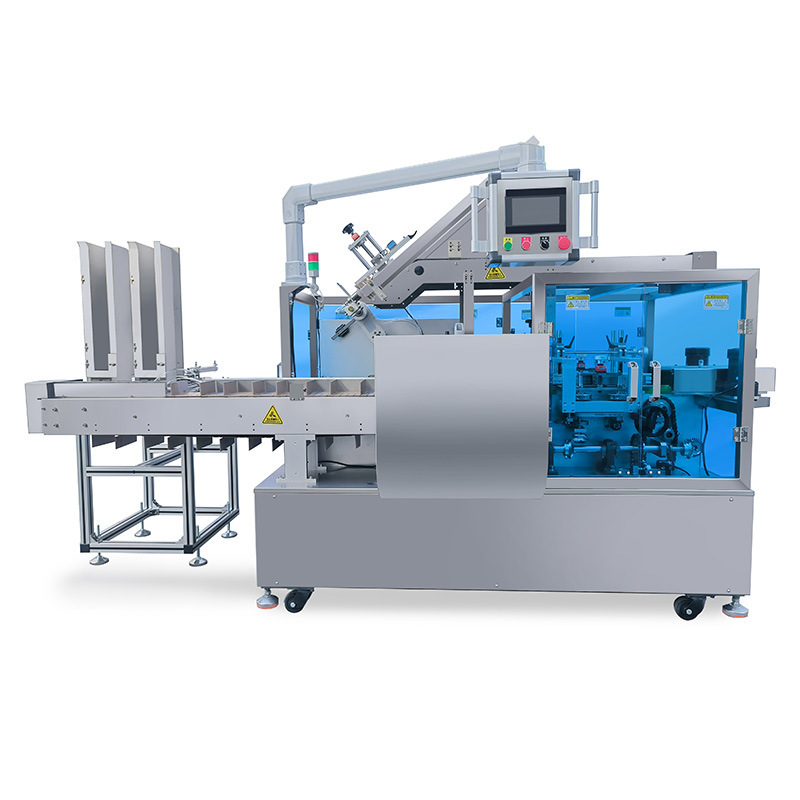
You can tell a lot about a plant by walking to the end of the line. The bagger runs at 90 packs a minute, beautifully, and then four people stand around a table putting bags into cartons by hand. That table is usually where the money is leaking.
Case packing is the least glamorous purchase in the building and often the fastest to pay back. But it is also where buyers overspend, because the jump from manual to robotic is not the only option.
Start with the labour math
Count the people at the end of the line and what they cost fully loaded: wage, benefits, supervision, recruitment, and the days they do not come in.
Take a line running 5,000 bags an hour into 12-bag cartons. That is roughly 417 cartons an hour, or 7 a minute. Two people can manage that by hand, and they will be tired by the end of the shift. At 24 bags per carton, it is 208 cartons an hour, and one person can keep up.
Now double the line speed. Two people become four, and four people at 7 cartons a minute is not a plan, it is a bottleneck with a backache. This is the point where automation stops being a luxury.
Level 1: manual packing, done properly
Manual is not the same as bad. Before you spend anything, fix the table: correct height, a carton former within reach, a bag chute that presents the bag the right way up, and a scale to check counts. A 600 dollar ergonomic rebuild often buys 20 percent more throughput.
Set a hard limit. When your line needs more than three people on packing, or when you start hearing about wrist and shoulder injuries, manual has stopped being cheap.
Level 2: semi-automatic
This is the sweet spot most small and mid-size plants should look at first. A semi-automatic case erector plus a manual or semi-automatic top sealer gives you one operator instead of three, at 15,000 to 30,000 dollars.
Typically 15 to 25 cartons a minute, one operator loading, machine erecting and sealing. It is forgiving, changeover is easy, and it does not need a controls engineer when something goes wrong.
What it does not do is remove the operator. If your labour cost is the whole problem, this only halves it.
Level 3: automatic
Three families, and they are not interchangeable:
Drop packers let bags fall into an erected case through a funnel. Cheap, fast, and best for flexible bags that can take a small fall. 30,000 to 60,000 dollars.
Wrap-around packers form the carton around the product from a flat blank. Excellent for cans, jars, and rigid packs, and it saves board. 60,000 to 120,000 dollars, and it locks you into one carton style.
Robotic pick and place picks bags or pouches and places them in a case or a tray. Flexible, gentle, handles multiple patterns, and 80,000 to 150,000 dollars before integration.
Which one fits your carton
Your existing carton decides more than your budget. A top-loading RSC case suits a drop packer. A wrap-around blank suits nothing else. A tray with a lid suits a robot. If your retail customer specifies the case, work backwards from that specification, not from the machine brochure.
The integration problems nobody quotes for
- Accumulation. A case packer cannot take bags at a perfectly even rate, so you need a buffer between the bagger and the packer, or the bagger will stop and start all day.
- Speed mismatch. Buying a 25 carton per minute packer for a line that produces 30 is how you create a permanent 20 percent loss.
- Changeover. A machine that takes 40 minutes to change carton size will be run on one size forever, whether that suits your orders or not.
- Floor space. Case packing needs length. Measure the room before you fall in love with the machine.
Payback, roughly
A plant replacing three packers with a semi-automatic system at 25,000 dollars: three people at 22,000 dollars fully loaded is 66,000 a year, and the machine needs one operator, so the saving is about 44,000 a year before maintenance. Payback under eight months, ignoring everything else.
At that maths, the question is not whether to automate, but why it took so long.
When not to automate
If you run short batches with frequent carton changes, if your product mix changes weekly, or if your line runs four hours a day, a semi-automatic machine plus a well-designed table is probably the correct answer. Automation rewards repetition.
If you are automating the bagging end first, our cartoning machine range covers the step between bagging and case packing, and this ROI breakdown shows how to put labour into the total cost model.
Frequently asked questions
At what volume does a case packer pay for itself?
Roughly when you need three or more people on packing, or above 15 cartons a minute sustained. Below that, semi-automatic equipment usually pays back faster with less risk.
Can one case packer handle several carton sizes?
Yes, with change parts that typically take 20 to 60 minutes. Ask to see the changeover performed, and ask what the parts cost, because a full set can run 5,000 to 15,000 dollars.
Is a robot always more flexible?
More flexible in pattern, less flexible in speed and cost. A robot placing 40 bags a minute is realistic; a drop packer at 60 is cheaper and simpler if your product can take the fall.
Do I need a carton erector too?
If you are running automatic packing, yes. Hand-erected cases at 30 a minute is not sustainable, and the erector is usually the cheapest part of the line.