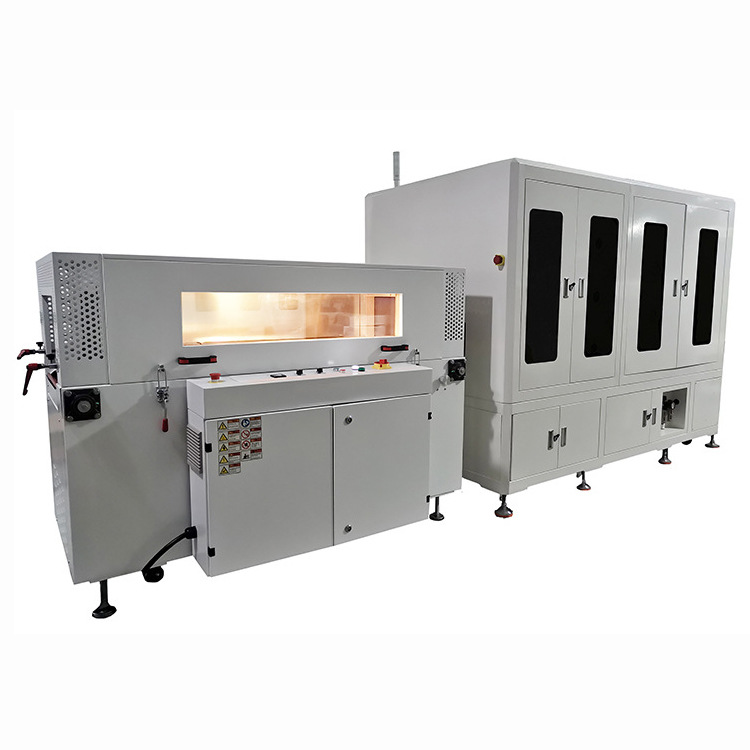
Put two videos side by side and a premade pouch machine and a VFFS look like cousins. Both drop product into a bag, both seal, both count output on a screen. Buyers compare the two quotes, see numbers in the same range, and pick the one with the nicer bag sample.
Then the film invoices start arriving, and the two machines turn out to live in completely different economies.
The difference in one paragraph
A VFFS machine takes flat film off a roll, forms it into a tube over a shoulder, fills it from above, and seals top and bottom. You buy film by the kilo. A premade pouch machine takes bags that were printed, laminated, and sealed on the sides by a converter, picks one up, opens it, fills it, and seals the top. You buy finished bags by the thousand.
That is the whole story. Everything else follows from who makes the bag and when.
Where the money actually goes
Film and pouches are the largest line item in the comparison and the one most often left out of it. A rough working range for a printed stand-up pouch with a zipper, at retail quality, is 8 to 14 US cents per bag in moderate volumes. Roll film for the same bag size and barrier, printed, typically lands somewhere between 3 and 6 cents per bag. The gap is not small.
Run it on a real number. Say you pack 5,000 bags a day, 300 days a year. That is 1.5 million bags.
- Premade pouches at 9 cents: 135,000 dollars a year in packaging material
- Roll film at 3.5 cents: 52,500 dollars a year
- Difference: 82,500 dollars a year
Now look at the machine quotes again. If the pouch machine is 15,000 dollars cheaper, that advantage disappears in about nine weeks of production. This is why the answer to “which machine is cheaper” is almost never the answer to “which machine costs less”.
Where premade pouches are worth every cent
Cheap is not the same as right, and there are plenty of products where roll film is the wrong choice.
- Bag features you cannot form inline. Spouts, slider zippers, shaped bottoms, clear windows, matte/gloss combination printing, foil stamping. A VFFS can add a zipper, but the bag will never look like a converted pouch.
- Shelf presence. If your product sits on a retail shelf next to three competitors, the pouch is a marketing asset and the film saving is irrelevant.
- Heavy or awkward product. Two kilos of pet treats, chunks in sauce, hardware kits. Premade pouches arrive with a real bottom gusset that holds weight.
- Low volume, many SKUs. Twenty flavours at 3,000 bags each. You cannot justify twenty printed film rolls, but you can order twenty pouch SKUs at a converter’s minimum.
- No printing budget. Pouch converters will run small lots with digital print. Film printers will not.
Where roll film wins without much argument
- Cost per bag at volume. Nothing beats forming the bag from film on the same machine that fills it.
- Speed. Modern VFFS units run 80 to 120 bags a minute on snacks, and small sachets go far higher. Pouch machines typically sit between 30 and 60 depending on the filling system.
- Warehouse space. One pallet of film rolls replaces six pallets of finished pouches. If your building is already full, this matters more than the spreadsheets suggest.
- Supply chain simplicity. One film supplier, one lead time, no risk of a pouch shortage stopping the line.
- Waste handling. Trim waste is continuous and easy to collect. Pouches that fail to open get thrown away whole, which stings at 9 cents each.
The comparison table, with real ranges
| Factor | Premade pouch machine | VFFS |
|---|---|---|
| Packaging cost per bag | 8 to 14 cents | 3 to 6 cents |
| Machine price, entry | 18,000 to 35,000 USD | 9,000 to 25,000 USD |
| Machine price, high end | 60,000 to 120,000 USD | 35,000 to 100,000 USD |
| Output | 30 to 60 bags per minute | 60 to 120 bags per minute |
| Film minimum order | 20,000 to 50,000 pouches per SKU | 100 to 300 kg per SKU |
| Changeover between sizes | 20 to 45 minutes, mostly gripper and format parts | 10 to 30 minutes, mostly bag length and former |
| Bag styles | Stand-up, flat bottom, three-side seal, spout, slider | Pillow, gusset, quad seal, doypack with attachment |
| Best product fit | Chunky, heavy, premium, low volume | Free-flowing, high volume, cost-driven |
The three-year comparison, not the purchase order
Build a simple sheet with four columns: machine and installation, packaging material over three years, labour, and expected waste. Then add one more column most buyers forget, which is the cost of a format change. A pouch machine that needs 40,000 dollars of gripper sets to move from a 200 g to a 500 g pouch is not a flexible machine, it is two machines sharing a frame.
Run the same three-year sheet for a VFFS with a zipper attachment if you are somewhere in the middle. The bag is not as handsome as a converted pouch, but it costs half as much and it opens the snack and frozen categories for you.
What usually decides it
In our experience, three things decide this comparison, in this order: the bag has to look a certain way on the shelf, the annual volume has to justify the material cost, and the product has to survive the drop into the bag. If the shelf look wins, buy the pouch machine and stop arguing about film. If volume wins, buy the VFFS and invest the difference in a better weigher, because a cheap weigher on a fast machine produces expensive waste.
And if you genuinely cannot decide, ask both suppliers for a sample test with your product and run the numbers for 1,000 finished bags, all in, including film, labour, and rejects. The answer is usually obvious once you are counting finished bags instead of reading brochures.