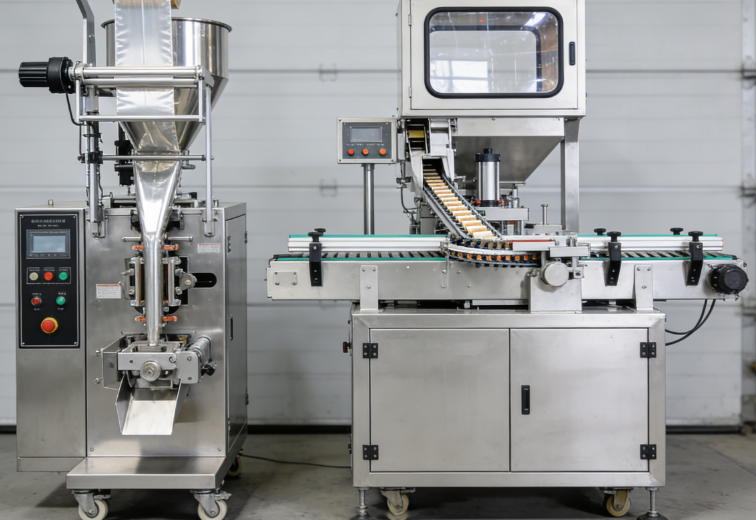
When buyers search for an automatic packaging machine, the first technical decision is usually: vertical or horizontal? Both are form-fill-seal systems, but they excel in different applications. This side-by-side buying guide compares VFFS and HFFS across 8 critical criteria.
What is a Vertical Form Fill Seal (VFFS) Machine?
VFFS machines pull flat film vertically, form it into a tube around a forming shoulder, fill product from above, and seal both bottom and top. They are ideal for free-flowing powders, granules, liquids, and small solid items.
What is a Horizontal Form Fill Seal (HFFS) Machine?
HFFS machines move film horizontally. Products are placed onto the lower film web, then the upper web covers them, and longitudinal and transverse seals are made. They are preferred for fragile, irregular, or large items like cookies, medical devices, or hardware.
Comparison Table: VFFS vs HFFS
- Bag styles: VFFS produces pillow, gusseted, quad-seal, and stand-up pouches. HFFS produces pillow, fin-seal, and three-side-seal bags.
- Product integrity: VFFS drops product vertically (can damage fragile items). HFFS gently places product onto film – better for chips, biscuits, and plastic parts.
- Footprint: VFFS has a small footprint (approx. 3–4 m²). HFFS requires longer length (often 6–10 m) for product infeed.
- Speed: VFFS can reach 200+ PPM for small bags. HFFS typically 30–120 PPM depending on product length.
- Film cost: VFFS uses up to 10% less film because of efficient forming. HFFS has higher film waste due to sealing margins.
- Changeover: VFFS changeover (bag length/width) takes 10–30 minutes. HFFS changeover (product format) can take 30–90 minutes.
- Price range: Entry-level VFFS $8k–$20k; industrial VFFS $30k–$100k. HFFS starts at $25k for basic models, up to $200k for high-speed servo-driven units.
When to Choose VFFS
Select VFFS if: your product is free-flowing or a liquid; you need stand-up pouches or gusseted bags; floor space is limited; you want lower film consumption; you run high volumes of the same bag size.
When to Choose HFFS
Select HFFS if: your product is fragile (cookies, wafers, electronic components); products have varying shapes (e.g., auto parts); you need to include a tray or insert; you already have a horizontal product conveyor.
Hybrid Solutions and Special Cases
Some manufacturers offer “vertical intermittent motion” machines that handle fragile products with a gentle drop platform. Also, robotic pick-and-place systems can feed fragile items into VFFS, but at higher cost. For extremely sticky or heavy products (like frozen meat blocks), a horizontal system with a bottom support belt is safer.
Real Buyer Example
A snack company packaging potato chips initially chose VFFS due to lower price. After 20% breakage rate, they switched to HFFS with a weigher that gently tips chips onto film. Breakage dropped to 2%, justifying the higher machine cost within 4 months.
This guide shows that neither VFFS nor HFFS is universally better. Match the machine type to your product’s physical characteristics and desired bag style. For a detailed recommendation, request a sample test from both VFFS and HFFS suppliers.