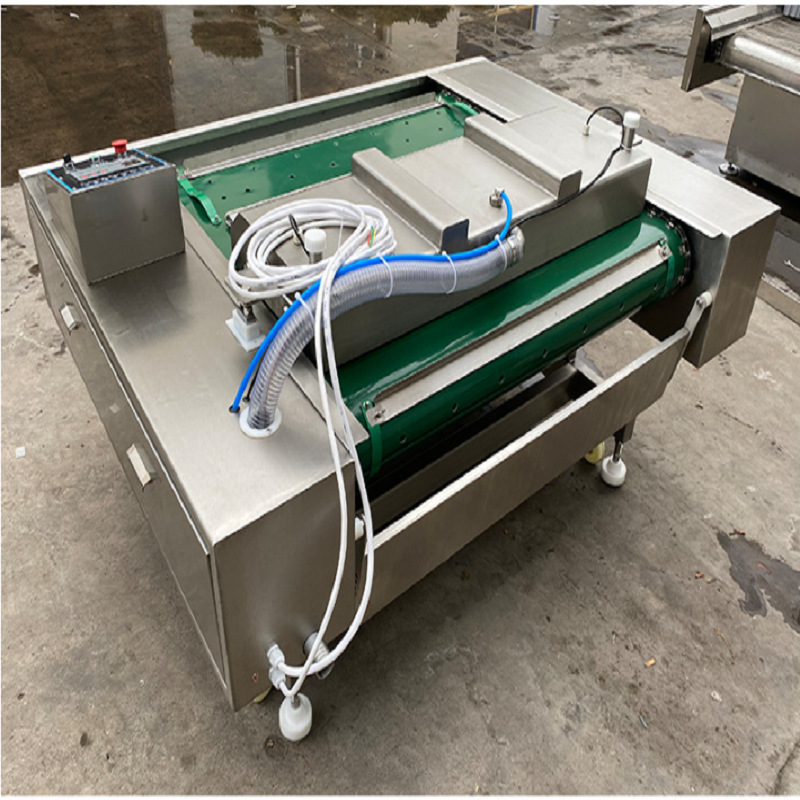
Both machines remove air from a pack and seal it. That is where the similarity ends, and buyers who treat them as one category usually end up with the wrong machine for their volume.
The fundamental difference
A chamber vacuum sealer puts a filled pouch inside a chamber, pulls a vacuum on the whole chamber, seals the pouch, and releases. The pack is a bag.
A thermoforming vacuum packer takes two rolls of film, heats the bottom film and forms it into a tray shape, loads product into that formed cavity, vacuum seals the top film over it, and cuts the packs apart. The pack is a rigid-ish tray with a soft lid.
One machine is a batch process built around a bag. The other is a continuous process that makes its own container.
Output, honestly
A single chamber machine runs 1 to 3 cycles a minute, and every cycle has a dead time while the chamber pulls down and releases. A double chamber machine lets the operator load one side while the other seals, so you get closer to 4 to 6 cycles, but you are still batching.
A thermoforming machine runs continuously, typically 4 to 12 cycles a minute depending on pack size and film, with no chamber dead time. At the top end it is a different order of throughput, which is why it dominates in meat and cheese plants.
Cost per pack, and it is not obvious
Pouches cost money per unit. Thermoforming film costs money per square metre, and a formed tray uses more material than a flat pouch for the same product. On paper, the pouch is often cheaper for small packs.
But add labour: a chamber machine needs an operator loading bags every cycle, all day. A thermoforming line needs one operator supervising. At 3,000 packs a shift, labour usually outweighs the film difference. Do the arithmetic on your own numbers before you assume pouches are cheaper.
Where a chamber machine is the right answer
- Low to medium volume, under roughly 1,500 packs a shift
- Very large or very tall products that will not fit a formed cavity, such as whole hams or large cheese blocks
- Liquids and wet product, where a pouch is simply easier to handle
- Multiple products with no format investment – change the bag, not the mould
- Small budget. A double chamber machine at 6,000 to 12,000 dollars versus a thermoformer at 30,000 and up
Where thermoforming wins
- Retail presentation. The formed tray with a clear lid is the standard look in supermarkets for fresh meat, poultry, and fish
- Long runs. One product, one mould, thousands of packs a day
- Automation. It integrates naturally with a labeller, a metal detector, and a case packer
- Consistent pack dimensions, which matters enormously for downstream automation and for retail planograms
Skin pack is a third thing
Skin packaging heats the top film until it drapes over the product and seals to the bottom film, with no air gap at all. It looks premium, it stops product moving in the pack, and it is popular for steaks, seafood, and hardware. If you want that look, you need a skin packaging machine, not a standard thermoformer, and the film is a specialist item.
Maintenance differences that show up in year two
Chamber machines are mechanically simple but work hard: the vacuum pump runs constantly, the sealing bar takes abuse, and the chamber gasket is a wear item you will replace. Budget for a pump service and two gaskets a year.
Thermoformers add moulds, forming heaters, chain or film transport, and a cutting station. More to maintain, more to clean, and the moulds are expensive to change. Ask what a second format costs before you buy, because it is often 8,000 to 20,000 dollars.
Product constraints worth checking early
- Maximum product height, and how much the film can stretch over a sharp edge
- Bone-in product, which needs a thicker bottom film or a barrier board
- Liquids, which need a different sealing sequence and often a different machine
- Frozen product, where condensation between the films ruins seals
If you are packaging meat, cheese, or ready meals, also read our guide to matching film to machine, because vacuum packs fail at the film interface far more often than at the pump. You can see both machine families in the vacuum packaging range.
Frequently asked questions
Can a chamber machine pack 5,000 units a day?
Only with multiple machines or very long shifts. A double chamber unit realistically handles 1,500 to 2,500 packs a shift. Above that, thermoforming or a continuous belt machine is the better fit.
Which gives a longer shelf life?
Similar, if the residual oxygen is the same. Thermoforming often achieves lower residual oxygen because the pack is formed and sealed in one cycle, but a good chamber machine with a deep vacuum and a clean seal is close.
Do I need a different film for each?
Yes. Pouches are pre-made laminates; thermoforming needs a formable bottom web and a sealable top web with matched sealing layers. They are not interchangeable, and buying the wrong one is an expensive mistake.
Can I run both?
Plenty of plants do: a thermoformer for the retail line and a chamber machine for bulk, samples, and odd sizes. If your volumes justify it, that is usually cheaper than trying to make one machine do everything.