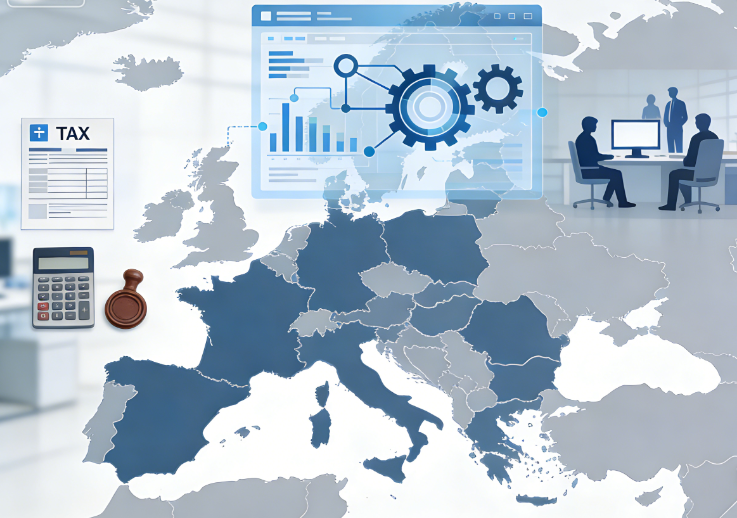
Expanding across Europe is a growth strategy for many companies, but payroll complexity multiplies with every new country. Each of the 15+ European nations has its own tax codes, social security contributions, reporting deadlines, and language requirements. Payroll software supporting 15 European countries with local tax compliance provides a unified platform to run payroll accurately, file statutory reports, and pay employees in local currencies – all while adhering to GDPR and country‑specific labor laws.
The Challenge of Pan‑European Payroll
Even within the EU, harmonization is limited. Key differences include:
-
Income tax – Progressive rates vary wildly (e.g., Bulgaria 10% flat vs. Sweden up to 57%).
-
Social security – Employer contribution rates from ~10% (Denmark) to ~30% (France).
-
Public holidays – Different by country, region, and even city.
-
13th/14th month salaries – Mandatory in Spain, Italy, Austria, etc.
-
Payroll frequency – Monthly (most), semi‑monthly (France), weekly (UK some sectors).
-
Year‑end reporting – Forms like P60 (UK), DAS (Germany), 2042 (France).
-
Works councils – Some countries require union approval for payroll changes.
Using separate local payroll providers leads to data silos, inconsistent employee experiences, and high administrative overhead. A unified European payroll software solves these.
Core Features of Cross‑Border Payroll Software
-
Multi‑country tax engine – Automatically applies correct tax tables and social security rates based on employee work location.
-
Local statutory reporting – Generates and files reports in local formats (e.g., ELMA in Germany, Fiche de paie in France).
-
Multi‑currency payments – Pay employees in EUR, GBP, CHF, SEK, PLN, etc., with bank file generation.
-
Language support – Interface in English plus local languages; payslips in employee’s preferred language.
-
GDPR compliance – Data processing agreements, right to erasure, and data transfer mechanisms (SCCs).
-
Leave and attendance integration – Handle country‑specific leave entitlements (e.g., 25 days in UK, 30 in France).
-
Pension auto‑enrolment – UK’s NEST, Germany’s bAV, etc.
-
Employee self‑service – Employees access payslips, tax certificates, and update bank details.
Supported Countries (Typical 15)
Most pan‑European solutions cover:
Austria, Belgium, Denmark, Finland, France, Germany, Ireland, Italy, Netherlands, Norway, Poland, Portugal, Spain, Sweden, Switzerland, plus United Kingdom (often included). Some also cover Czech Republic, Hungary, Romania.
Benefits for HR and Finance Teams
-
Single source of truth – One system for all countries; no reconciliation across spreadsheets.
-
Reduced error rate – Automated tax calculations eliminate manual errors that trigger penalties.
-
Faster month‑end close – Run all 15 countries’ payrolls in hours instead of weeks.
-
Audit readiness – Centralized audit trail shows compliance for every country.
-
Scalable expansion – Add a new country by turning on a configuration, not hiring a new provider.
-
Cost savings – Consolidated pricing vs. 15 separate contracts.
Leading Payroll Solutions for 15+ European Countries
-
CloudPay – Specializes in global payroll; supports 130+ countries, strong in Europe.
-
Paylocity – Growing European footprint.
-
Papaya Global – Unified workforce management; excellent for EMEA.
-
Deel – Strong for remote teams; handles contractor and employee payroll.
-
Remote – EOR plus payroll in 15+ European countries.
-
Personio – HRIS plus payroll (currently Germany, Austria, Switzerland, UK, France, Italy, Spain, Netherlands).
-
SD Worx – Strong in Benelux, France, Germany, UK, Austria.
Note: Always verify current country coverage as providers expand rapidly.
Implementation Considerations
-
Data migration – Map historical payroll data from local providers to the new system.
-
Integration with HRIS – Employee master data (name, address, tax class) should flow automatically.
-
Calendar alignment – Each country has its own payroll run calendar; the software must handle multiple deadlines.
-
Local support – Even with software, you need in‑country payroll experts for questions on new legislation.
-
Testing – Run parallel payroll for one quarter (old system vs. new) to validate accuracy.
Common Compliance Pitfalls
-
Cross‑border remote workers – An employee living in France but working for German entity triggers complex social security rules (A1 certificates).
-
Double taxation – Ensure tax treaties are applied correctly in the software.
-
Posting notifications – Some countries require notification to labor authorities for foreign employees.
-
Data localization – Payroll data for France and Germany may need to reside within those countries.
-
Collective bargaining agreements – Industry‑specific minimum wages and benefits (e.g., metalworkers’ union in Germany).
Your payroll software must allow configuration of these nuances.
Cost Structure
Pricing for pan‑European payroll typically includes:
-
Per employee per month (PEPM) – €8–€20 depending on country complexity.
-
Implementation fee – €10k–€50k for 15 countries.
-
Additional per‑country setup – Some charge per country activation.
-
Integration fee – Connecting to your HRIS or ERP.
For 1,000 employees across 15 countries, annual software cost could be €100k–€200k.
Future Trends
Real‑time payroll reporting to tax authorities (already in France, Spain) will become EU‑wide. AI will flag compliance risks – e.g., “Your employee in Italy is about to exceed overtime limits.” Embedded earned wage access (EWA) will allow employees to withdraw earned pay on demand.
Conclusion
Payroll software supporting 15 European countries with local tax compliance is not a luxury – it is essential for any company with distributed European workforce. Evaluate solutions based on country coverage depth (not just breadth), local support, and API integrations. A unified platform transforms payroll from a monthly scramble into a strategic asset.